.png) Call Us : 9779766482075
Call Us : 9779766482075
 Email: info@routehimalayaa.com


East & West Bhutan
Description
Bhutan is no ordinary place. It is the last great Himalayan kingdom, shrouded in mystery and magic, where a traditional Buddhist culture carefully embraces global developments. If you have time see the culture and traditions the 16 days itienrary will be enough. If you are planning the trip to India this tour will be the best choice as we can exit to Guwahati from Samdrup Jongkhar which is nearly 4 hours drive from Trashigang. From Guwahati we can take several flights to different parts of India.
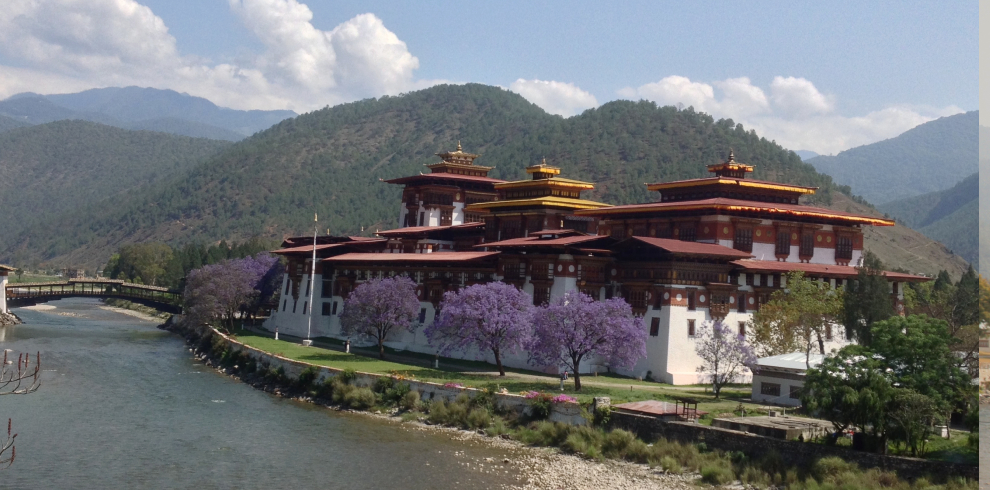
Some Beautiful Glimpes Of East & West Bhutan
Itinerary
The first thing you will notice as you disembark is the transparent purity of air and the absence of noise. The Paro valley has kept its bucolic nature inspite of the airport and the existence of development projects. Fields, brown or green depending on the season, cover most of the valley floor, while hamlets and isolated farms dot the countryside. The houses of Paro valley are considered to be among the most beautiful in the country. Paro is believed to be one of the first valleys to have received the imprint of Buddhism.
Afternoon: Visit the National Museum (Ta-Dzong). Once the watchtower for the Rinpung Dzong, it was converted into the National Museum in 1968. The museum stands on a promontory overlooking the Paro valley in all its glory. Visit the Paro Rinpung Dzong. A flagstone path rises gradually from a beautiful wooden bridge with shingle roofing and abutted by two guardhouses, to the Dzong. Today, the Dzong is the seat of the district administration as well as the home for the monastic school. The central tower of the Dzong, with its superb woodwork, is one of the most beautiful in the nation. The Dzong was built in 1645 A.D.Check in at Hotel
Overnight: Thimphu
Morning: Visit the Memorial Chorten, a huge stupa built in memory of the third King who reigned from 1952-1972.
Visit the National Library where ancient manuscripts are preserved.
Visit the Painting School where traditional art is still preserved. Artists are taught to paint Thankas here (sacred Buddhist scroll).
Visit the Handicrafts Emporium where one can buy Bhutanese textiles and other arts and crafts.
Visit the Weekend market where vendors from throughout the region arrive on Friday afternoon and remain till Sunday. Here you will find indigenous goods, handicrafts, locally produced goods, etc.
Afternoon: Visit Semtokha Dzong. This is the oldest fortress in Bhutan, built in 1629 A.D. by Shabdrung Ngawang Namgyal. It also houses the largest monastic schools in the country.
Visit Tashichho Dzong – the main secretariat building. It is from here that the King and other prominent civil servants run the country. The Head Abbot and the central monastic body also reside here during the summer.
Visit Pangri Zampa Monastery, situated just beyond Dechencholing Palace (5 km. from Thimphu). This temple was the first residence of Shabdrung Ngawang Narngyal when he arrived in Bhutan in 1616 A.D. It was built during the first quarter of the 16th century by Ngawang Chogyel, the great ancestor of the Shabdrung.
Overnight: Thimphu
After breakfast you will be transfered to Punakha/Wangdue. En-route stop at Dochula Pass (3150 m), 30 km from Thimphu, for tea and biscuits and enjoy a view of the Eastern Himalayan Mountains. From Dochula to Wangdue, it’s another two hours drive.
Wangdue Phodrang Dzong is perched on a spur at the confluence of 02 rivers. The position of the Dzong is remarkable as it completely covers the spur and commands an impressive view over both the north-south and east-west roads. The main road climbs the length of the spur and on the left, across the river, comes the first glimpse of the picturesque village of Rinchengang whose inhabitants are celebrated stonemasons.
After lunch in Lobesa, visit the Punakha Dzong. This is the winter residence of Bhutan’s spiritual leader, the Head Abbot, and the Central Monastic Body. The Dzong is built between two rivers known as “Phochu” (Male River) and “Mochu” (Female River).
On the way back to Wangdue Phodrang stop at Metshina. On a hillock in the center of the valley below Metshina is Chimi Lhakhang (Fertility Monastery), built by lama Drukpa Kunley in 1499. It’s a 20-minute walk across the rice fields from the road at Sopsokha to the temple. The trail leads across rice fields to the tiny settlement of Pana. There are very few monks at the temple which is surrounded by a row of prayer wheels and some very beautiful slate carvings.Check into Hotel.
Overnight: Wangdue
It takes almost four hours to drive between the windswept town of Wangdue and Trongsa. The route crosses the Black Mountains via Pele la before entering the broad, heavily cultivated Mangde Chhu Valley. From Pele la the road drops through more dwarf Bamboo and patches of fir trees emerging into the abundant evergreen forest of the Longte Valley. The road follows the Nikka Chhu (River) to the village of Chendebji which is on the opposite side of Nikka Chhu. Two kilometers beyond Chendebji village is Chendebji Chorten, a large white structure beside a stream.Stop for a picnic lunch at Chendebji. Continue drive to Trongsa.
Overnight: Trongsa
Morning: Visit the Trongsa Dzong and the Watch Tower. The Trongsa Dzong was the ancestral home of the ruling dynasty. It is also the district administration office of the Trongsa district. It was built in 1648 A.D.
The view from the Dzong extends for many kilometers and in former times nothing could escape the vigilance of its watchmen. Furthermore, the Dzong is built in such a way that in the old days, no matter what direction a traveler came from, he was obliged to pass by the Dzong. This helped to augment its importance as it thus had complete control over all east-west traffic.
Visit the Ta-Dzong, an ancient Watch Tower of the Trongsa Dzong is located on top of a steep hill about 1 km beyond the Trongsa Dzong. The watchtower displays many interesting armors used by the Bhutanese soldiers during the olden days.
Lunch at the hotel and leave for Bumthang (68 Km). The journey takes about 3 hrs and is over one of the most scenically beautiful routes in Bhutan.
Overnight: Bumthang
Morning: Jakar Dzong is in a picturesque location overlooking the Choskhor Valley. The current structure was built in 1667 and is said to be the largest Dzong in Bhutan, with a circumference of more than 1500 m. Its official name is Yuelay Namgyal Dzong, in honour of the victory over the troops of Tibetan ruler Phuntsho Namgyal.
Tamshing Goemba (also known as Tamsing lhendup Tsholing, literally ‘temple of the good message’) was established in 1501 by Pema Lingpa and is the most important Nyingmapa Goemba in the kingdom. Pema Lingpa built the structure himself, with the help of Khandroms (female celestial beings) who made many of his statues.
A short distance below Tamsing is a small rural-looking town Konchogsum Lhakhang – the source of many interesting stories. The history of this temple dates back to the 6th century, however the current structure dates from 15th century, when Pema Lingpa restored it. The small statues of the 3 Buddha (past, present & future) in the sanctuary are said to have flown straight from Khaine Lhakhang in Kurtoe. Hence the name of this Lhakhang is Konchogsum – Konchog (divine being), sum (three).
It’s a five-minute walk from the parking spot alongside the road to Membartsho (Burning Lake), which is actually a wide place in the Tang Chhu. Pema Lingpa found several of Guru Rimpoche’s terma here. A wooden bridge crosses the river and is a good vantage point to look down into the lake.
Overnight: Bumthang
It takes about seven hours to cover the 193 km between Jakar and Mongar, crossing two passes and traversing several wild roads that cling to the hillsides. It is one of the most spectacular drives in the country, descending 3200 m in a distance of 82 km. The forest is mostly fir with undergrowth of several varieties of rhododendrons, including some with large red and pink flowers and others with small yellow blossoms. If you are lucky enough to travel on a clear day, watch for a view of Gangkar Phuensum as you approach the pass. The eastern side of the pass is much rockier. There is a settlement at Sengkor of a few houses near the road. If you are carrying a picnic lunch and have not eaten it, this is an excellent place to do so.
The next stretch of the road is the wildest in Bhutan. Five kilometers beyond the Sengkor valley the road begins a steep descent into the Kuri Chhu valley, clinging to the side of a rock cliff with numerous streams and water falls leaping out onto the road. It’s often foggy and cloudy on this side of the pass, making it difficult to see what’s below – which is fortunate. There are several chortens here – erected as memorials to Indian and Nepali contract labourers who were killed during the construction of this portion of the road. After a long descent the traverses the side of the cliff, the road reaches safer ground. Atop a hill on the opposite side of the river, near the kilometer marker 123 is a view of the ruins of Shongar Dzong. The road to Mongar climbs through chir pine forests up the eastern side of the Kuri Chhu Valley.
Overnight: Mongar
Morning Visit the Mongar Dzong. Mongar Dzong is a new Dzong, completed recently. It was built in the 19th century, restored in 1953 and again in 1990 after being gutted by a fire. The administrative scat and the monk body reside in the Dzong. After Lunch drive to Trashigang.
The Mongar to Trashigang stretch is easier and shorter than the journey from Jakar to Mongar, but it still requires 3 and half hours to cover the 92 km between the two towns. The road crossed one low pass, then follows a river valley before making a final climb to Trashigang.
Overnight: Trashigang
Trashigang is one of the most densely populated districts in Bhutan. After Thimphu, Trashigang is the biggest urban center in mountainous Bhutan. It is the heart of eastern Bhutan and was once the center of important trade with Tibet. There are several goembas and villages that make a visit worthwhile, but it is a remote region and requires a lot of driving to reach. It is a good base for excursion to Trashi Yangste, Khaling, Radi Phongme and elsewhere in eastern Bhutan.
Visit the famous Trashigang Dzong. The Dzong precariously hugs a spur at more than 400 m, jutting out over the Gamri River. The Dzong commands a remarkable view of the surrounding countryside. Built in 1659 A.D. it is practically impregnable, protected on three sides by the river and ravines, and from behind by the mountains. After lunch, take a leisurely stroll through Trashigang town.
Overnight: Trashigang.
Previously a drungkhag (sub district) of Trashigang, Trashi Yangste became a full-fledged dzongkhag in 1993.
The drive from Trashigang to Trashi Yangste is 53 km and takes about 1hr 45 minutes. Follow the switchbacks down to the bridge at Chazam. The road winds its way through sparse clump of chir pine above the west bank of Drame Chhu to Gom Kora.
Two kilometers from Gom Kora is the substantial village of Duksum. There are many shops and small eating places here, many of the shops sell particularly colorful patterned cloth that is woven by the women of the village using back-strap looms. The road turns northwest and follows the Kulong Chhu valley towards Trashi Yangtse.
In Trashi Yangtse, you can visit the popular Chorten Kora, one of few stupas constructed in Nepali (Sherpa) style. It was built to mark the site where Guru Rimpoche subdued many malevolent beings. According to local tradition, the architectural model of the stupa was brought from Nepal, carved on a raddish. Visit the traditional woodcraft workshop where typical Bhutanese bowls and other wooden items are made. (These products are very popular in Bhutan). If you have time, you can spend one more day in Trashi Yangtse to walk to Bumdeling for a glimpse of Yaks, and trout fishing. Picnic lunch at Trashi Yangtse and return to Trashigang.
Overnight: Trashigang
You can exit to Guwahati of India from Samdrup Jongkar if you have fewer days to Travel Bhutan.
OPTIONAL: We can either leave the country from Guahati (India) through Samdrup Jongkhar, 180 km South of Trashigang, or return to Paro through the same route as indicated below. The drive from Samdrup Jongkhar to Gauhati in India takes about 4 hours.
Overnight: Bumthang/Samdrup Jongkhar
After breakfast drive to Phobjikha. Follow the same route back to Trongsa & Wangdue and after you cross Pele La the road diverts to Gangtey Valley which is just 5 km. To the Bhutanese, going to Gangtey is like going back in time, an interesting perspective given that they themselves live in a country right out of the pages of King Arthur’s Court. Picnic lunch at Chendebji Chorten.
Overnight: Phobjika
Morning: Your first stop should be at the RSPN (Royal Society for Protection of Nature) its open 7 am - 7 pm Monday to Friday. It has formative displays about the cranes and the valley environment. The center of the valley is wetland and is the winter residence of a flock of 200 – 300 rare and endangered black-necked cranes.
Gangtey Goemba overlooks the large green expanse of the Phobjikha Valley. The extensive complex consists of the goemba and several other buildings, which include monk, quarters, meditation centers, school and small hotel. In the front of the yellow roofed goemba is a Tibetan style chorten with a wooden roof. Drive to Thimphu (optional) for lunch or continue drive to Paro.
Overnight: Paro
Taktsang is the most famous of all Bhutanese monasteries. It is perched on the side of a cliff 900 m above the floor of the Paro valley, where the only sounds are the murmurs of the wind, and water and the chanting of the monks. The name Taktsang means ‘Tigers Nest’; the Guru is said to have flown on the back of a tigress to the site of the monastery where he meditated in a cave for three months.
The monastery itself is closed to tourists except by special permit. However the one-hour walk to the viewpoint, where there is a small wooden teahouse provides a close-up view of the monastery. It’s also a good warm-up hike if you are going trekking.
Overnight: Paro
Transfer to Paro airport for the departure flight
What's included?
• Arrival and departure airport transfers in Bhutan by private vehicle
• All accommodations (three stars standard) per itinerary
• All meals (breakfast, lunch, dinner, tea/coffee)
• All tours and entrance fees per itinerary
• All transportation and transfers per itinerary including the driver
• An English speaking local guide
• Bhutan visa and Tourism Development Fund (TDF) fee
Clothing
Warm Jackets with water proof or rain coats
Hiking shorts (for men) or skirt
Clothes as per the season
Hiking/trekking boots
Socks for hiking boots Sunscreen for lips and face
Sunglasses
Sneakers
Long and short T- shirts or cotton shirts
Sun Hats
Walking Sticks
Back pack or Suitcase
Dress code while entering monasteries and temples
Shirt (either half or full sleeve)
Full pants/long skirts
Any type of shoes with socks
No Hats, No Umbrella, No Slippers, No t-shirts, No short skirt and No half-pants
Photographs allowed in the courtyard only
Reviews
No reviews available yet.