.png) Call Us : 9779766482075
Call Us : 9779766482075
 Email: info@routehimalayaa.com


Central Bhutan Tour
Description
The Central Bhutan tour is an exceptional journey that starts from Nepal, taking travelers on a mesmerizing adventure through the heart of Bhutan. With its professional tone of voice, this exploration ensures an immersive experience that unveils the rich cultural heritage and natural splendors of this captivating country. From the moment you embark on this tour, you will be warmly greeted by knowledgeable guides and provided with seamless logistics to ensure a hassle-free journey. As you venture through the central region of Bhutan, you will discover ancient monasteries nestled in lush valleys, encounter friendly locals donning vibrant traditional attire, and relish the breathtaking landscapes that range from dense forests to majestic mountains. With carefully curated itineraries and attention to every detail, the Central Bhutan tour promises an unforgettable adventure that will leave you with cherished memories for a lifetime.
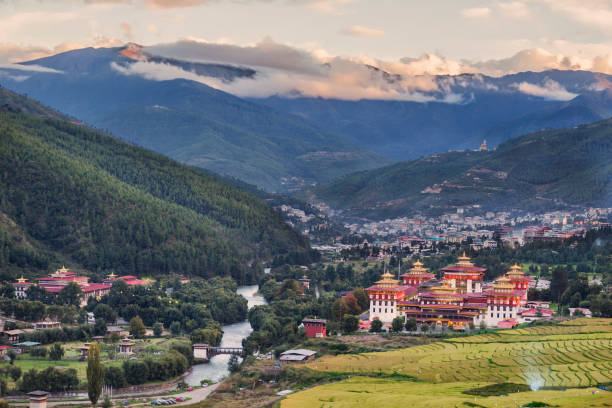
Some Beautiful Glimpes Of Central Bhutan Tour
Itinerary
The first thing you will notice as you disembark is the transparent purity of air and the absence of noise. Fields, brown or green depending on the season, cover most of the valley floor, while hamlets and isolated farms dot the countryside. The houses of Paro valley are considered to be among the most beautiful in the country. Afternoon: Visit the National Museum (Ta-Dzong) Overnight: Thimphu
Thimphu lies in a wooded valley, sprawling up a hillside on the West Bank of the Thimphu Chhu [Chhu means River]. Thimphu is unlike any otherworld capital. Small and secluded the city is quiet and there are never the traffic jams familiar in other Asian Capitals. It is often said that Thimphu is the only world capital without traffic lights. Thimphu’s main shopping street is a delight not so much for what you can buy there, but for the picture squeness of the architecture and national costume. Visit the Memorial Chorten, a huge stupa built in memory of the third King who reigned from 1952-1972.Visit the National Library where ancient manuscripts are preserved. Visit the Painting School where traditional art is still preserved. Visit the Handicrafts Emporium where one can buy Bhutanese textiles and other arts and crafts.Visit the Weekend market where vendors from throughout the region arrive on Friday afternoon and remain till Sunday. Here you will find indigenous goods, handicrafts, locally produced goods, etc. Afternoon: Visit Semtokha Dzong. This is the oldest fortress in Bhutan.
After breakfast transfer to Punakha/Wangdue. En-route stops at Dochula Pass, 30 km from Thimphu, for tea and biscuits and enjoys a view of the Eastern Himalayan Mountains. From Dochula to Wangdue, it’s another two hours drive. Wangdue Phodrang Dzong is perched on a spur at the confluence of 02 rivers. The position of the Dzong is remarkable as it completely covers the spur and commands an impressive view over both the north-south and east-west roads. The main road climbs the length of the spur and on the left, across the river, comes the first glimpse of the picturesque village of Rinchengang whose inhabitants are celebrated stonemasons.After lunch in Lobesa, visit the Punakha Dzong. On the way back to Wangdue Phodrang stop at Metshina. On a hillock in the center of the valley below Metshina is Chimi Lhakhang (Fertility Monastery), built by Lama Drukpa Kunley in 1499. It’s a 20-minute walk across the rice fields from the road at Sopsokha to the temple. The trail leads across rice fields to the tiny settlement of Pana. There are very few monks at the temple which is surrounded by a row of prayer wheels and some very beautiful slate carvings. Check into Hotel.Overnight: Wangdue
It takes almost four hours to drive between the windswept town of Wangdue and Trongsa. The route crosses the Black Mountains via Pele la (3240 m) before entering the broad, heavily cultivated Mangde Chhu Valley. From Pele la the road drops through more dwarf Bamboo and patches of fir trees emerging into the abundant evergreen forest of the Longte Valley. The road follows the Nikka Chhu (River) to the village of Chendebji which is on the opposite side of Nikka Chhu. Two kilometers beyond Chendebji village is Chendebji Chorten, a large white structure beside a stream. Stop for a picnic lunch at Chendebji. Continue drive to Trongsa.
Overnight: Trongsa
The landscape around Trongsa is spectacular, and for miles on the end the Dzong seems to tease you so that you wonder if you will ever reach Trongsa. The view extends for many kilometers and in the former times, nothing could escape the vigilance of its watchmen. Trongsa is separated from both the east and the west by mountain passes. The town had a large influx of immigrants from Tibet in the late 1950’s and early 1960’s and Bhutanese of Tibetan descent run most shops here. The Tibetans are so well assimilated into Bhutanese society that there is almost no indication of Tibetan flavour in the town. Morning: Visit the Trongsa Dzong and the Watch Tower. The Trongsa Dzong was the ancestral home of the ruling dynasty. Backing on to the mountain and built on several levels, the Dzong fits narrowly on a spur that sticks out into the gorge of the Mangde River and overlooks the routes south and west. The view from the Dzong extends for many kilometers and in former times nothing could escape the vigilance of its watchmen. Furthermore, the Dzong is built in such a way that in the old days, no matter what direction a traveler came from, he was obliged to pass by the Dzong. This helped to augment its importance as it thus had complete control over all east-west traffic. Visit the Ta-Dzong, an ancient Watch Tower of the Trongsa Dzong is located on top of a steep hill about 1 km beyond the Trongsa Dzong. The watchtower displays many interesting armors used by the Bhutanese soldiers during the olden days. Lunch at the hotel and leave for Bumthang (68 Km). The journey takes about 3 hrs and is over one of the most scenically beautiful routes in Bhutan.
Overnight: Bumthang
The Bumthang region encompasses four major valleys: Choskhor, Tang, Ura and Chhume. The Dzongs and the most important temples are in the large Choskhor valley, commonly referred to as Bumthang valley. The first temple is the oldest and was built in 1652 by Mingyur Tenpa, when he was Penlop of Trongsa. The second temple was built by Ugyen Wangchuk, the first king of Bhutan in 1900 when he was still Penlop of Trongsa. The third building in the complex is an elaborate three-storey lhakhang built by Ashi Kesang Wangchuk, in 1984 under the guidance of Diglo Khyentse Rimpoche. The small statues of the 3 Buddhas (past, present & future) in the sanctuary are said to have flown straight from Khaine Lhakhang in Kurtoe. Hence the name of this Lhakhang is Konchogsum – Konchog (divine being), sum (three). It’s a five-minute walk from the parking spot alongside the road to Membartsho (Burning Lake), which is actually a wide place in the Tang Chhu. Pema Lingpa found several of Guru Rimpoche’s terma here. A wooden bridge crosses the river and is a good vantage point to look down into the lake.
Overnight: Bumthang
After breakfast drives to Phobjikha. Follow the same route to Trongsa & Wangdue and after you cross Pele La the road diverts to Gangtey Valley which is just 5 km. The gravel road to Gangtey descends through fields of bamboo, emptying into a lowland valley of grass that falls within the borders of the Black Mountain Natural Park. To the Bhutanese, going to Gangtey is like going back in time, an interesting perspective given that they themselves live in a country right out of the pages of King Arthur’s Court.Picnic lunch at Chendebji Chorten.
Overnight: Phobjika
Phobjikha is a glacial valley on the western slopes of the black mountains. The valley is a designated conservation area and borders the Black Mountains National Park. Because of the large flock of black-necked cranes that winters here, it is one of the most important wildlife preserves in the country. In addition to the cranes, there are also muntjacks (barking deer), wild boars, sambars, Himalayan black bears, leopards & black foxes in the valley and surrounding hills. Morning:Your first stop should be at the RSPN (Royal Society for Protection of Nature) its open 7 am – 7 pm Monday to Friday. It has formative displays about the cranes and the valley environment. The center of the valley is wetland and is the winter residence of a flock of 200 – 300 rare and endangered black-necked cranes. Gangtey Goemba overlooks the large green expanse of the Phobjikha Valley. The extensive complex consists of the goemba and several other buildings, which include monk, quarters, meditation centers, school and small hotel. In the front of the yellow roofed goemba is a Tibetan style chorten with a wooden roof.Drive to Thimphu (optional) for lunch or continue drive to Paro.
Overnight: Paro
Taktsang is the most famous of all Bhutanese monasteries. It is perched on the side of a cliff 900 m above the floor of the Paro valley, where the only sounds are the murmurs of the wind, and water and the chanting of the monks. The name Taktsang means ‘Tigers Nest’; the Guru is said to have flown on the back of a tigress to the site of the monastery where he meditated in a cave for three months.The monastery itself is closed to tourists except by special permit. However the one-hour walk to the viewpoint, where there is a small wooden teahouse provides a close-up view of the monastery. It’s also a good warm-up hike if you are going trekking.
Overnight: Paro
Our guide will transfer to Airport for the departure flight.
What's included?
- Arrival and departure airport transfers in Bhutan by private vehicle
- All accommodations (three stars standard) per itinerary
- All meals (breakfast, lunch, dinner, tea/coffee)
- All tours and entrance fees per itinerary
- All transportation and transfers per itinerary including the driver
- An English speaking local guide
- Bhutan visa and Tourism Development Fund (TDF) fee
Clothing
- Warm Jackets with water proof or rain coats
- Hiking shorts (for men) or skirt
- Clothes as per the season
- Hiking/trekking boots
- Socks for hiking boots Sunscreen for lips and face
- Sunglasses
- Sneakers
- Long and short T- shirts or cotton shirts
- Sun Hats
- Walking Sticks
- Back pack or Suitcase
Dress code while entering monasteries and temples
- Shirt (either half or full sleeve)
- Full pants/long skirts
- Any type of shoes with socks
- No Hats, No Umbrella, No Slippers, No t-shirts, No short skirt and No half-pants
- Photographs allowed in the courtyard only
Reviews
No reviews available yet.